
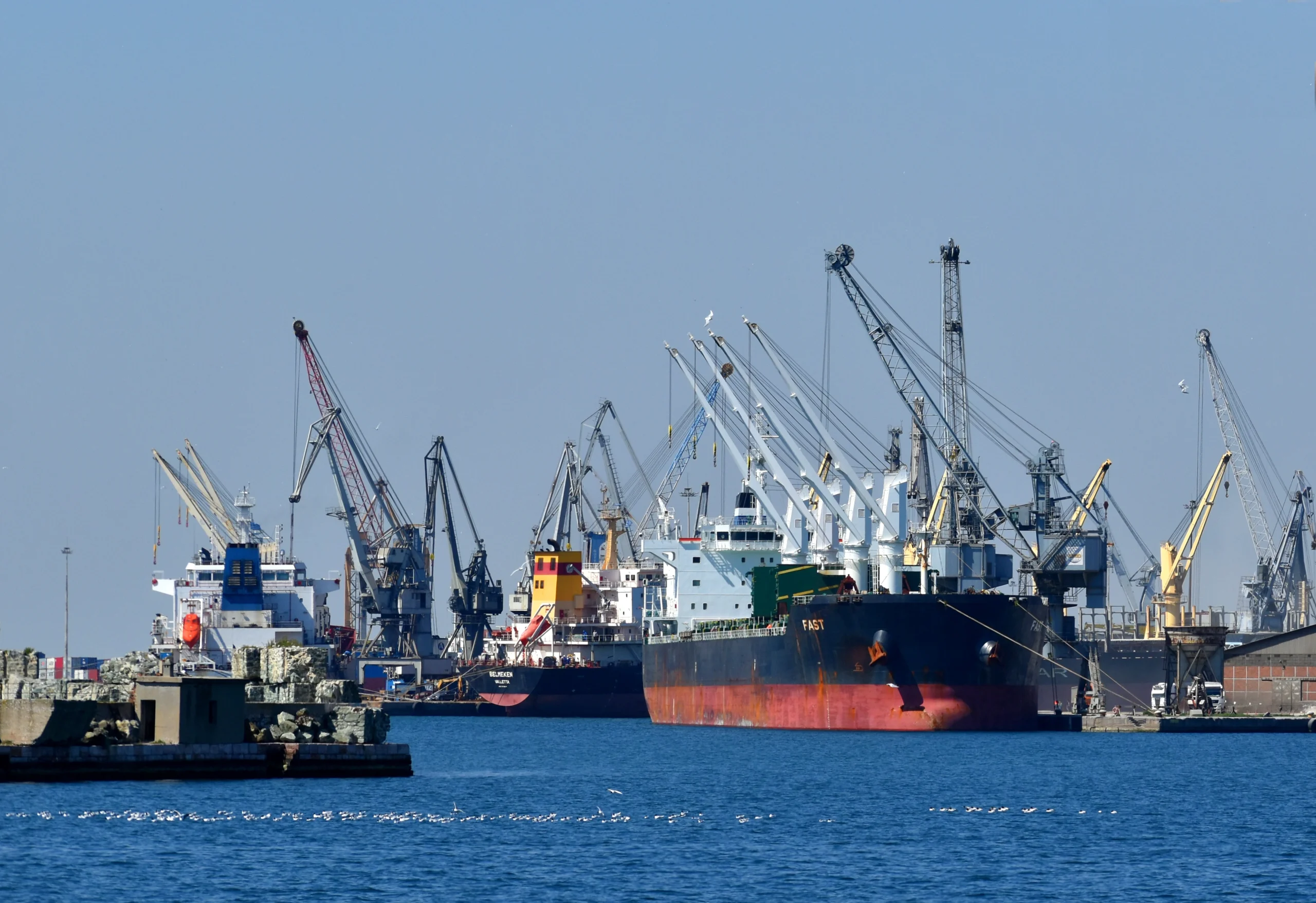
Search for yacht builders, repair yards, marine suppliers or marinas in the Mediterranean and the same companies tend to appear repeatedly.
They dominate specialist directories, Google results and industry articles. This creates the impression that the visible companies represent most of the market.
Our research suggests otherwise.
Using 2024 Eurostat business statistics, industry directories and individual company records, we compared the registered maritime business population in France, Italy, Spain, Greece, Croatia and Cyprus with the businesses appearing in a leading superyacht directory.
The result was striking: the directory contained listings equivalent to only 10.1% of the six-country yachting-core business population.
This does not mean that the remaining 89.9% have no website. It means they are absent from one of the industry's most visible directories — and that directory data alone cannot reliably describe the market.
A market of at least
29,027 core businesses
There is no official statistical category called "the yachting industry."
A shipyard, marina, marine engineer, charter company and yacht-equipment supplier may all serve the same market while being registered under completely different business classifications.
To create a defensible core population, we extracted enterprises registered under five directly relevant NACE classes:
30.11
Building of ships and floating structures
30.12
Building of pleasure and sporting boats
33.15
Repair and maintenance of ships and boats
52.22
Service activities incidental to water transportation
77.34
Renting and leasing of water-transport equipment
Across France, Italy, Spain, Greece, Croatia and Cyprus, these five classifications produced a combined total of 29,027 enterprises.
This remains a restricted definition. It does not capture every yacht broker, naval architect, marine electrician, interior specialist, sailmaker, provisioning company, surveyor or maritime lawyer whose principal registration code belongs to a broader professional category.
The real maritime and yachting ecosystem is therefore larger.
One directory contains
2,939 listings
Across the same six countries, Superyacht Guide published:
| Country | Directory listings |
|---|---|
| Italy | 1,339 |
| France | 741 |
| Spain | 454 |
| Greece | 247 |
| Croatia | 122 |
| Cyprus | 36 |
| Total | 2,939 |
That produces 2,939 directory listings, equivalent to approximately 10.1% of the 29,027 enterprises identified through the five core NACE classifications.
This percentage should be treated as an approximate coverage comparison, not a literal market share.
A directory listing is not necessarily the same thing as a registered legal enterprise. Directories may include branches, operational locations, brands or duplicate profiles. At the same time, official statistics may count businesses that serve commercial shipping rather than yachting.
Nevertheless, the scale of the difference is too large to ignore.
"The businesses most visible in industry directories represent only a narrow layer of the registered market."
Directory visibility is not
the same as online visibility
The figure describes how much of the registered market one directory captures. It says nothing about the online presence of the companies outside it.
Being absent from one directory does not mean a company has no website, Google Business Profile, social media account or other online presence.
Our website audit revealed another problem: even when a business is listed in a specialist directory, its profile may not include its website.
We audited 2,897 deduplicated directory candidates across France, Italy, Spain, Greece and Croatia.
The results were:
| Audit outcome | Profiles |
|---|---|
| Website link supplied by the directory | 1,643 |
| Additional websites found through independent checks | 6 |
| Still require website discovery and verification | 1,248 |
| Audited candidates | 2,897 |
This means 43.1% of the audited profiles did not supply a website link in the directory.
It does not mean that 43.1% of those businesses have no website.
That distinction is essential.
Six missing links —
and not one confirmed absence
To test whether an empty website field could be treated as evidence of website absence, we investigated six directory records whose profiles supplied no website.
| Directory record | Current website relationship |
|---|---|
| Uljanik | Direct company website |
| Dalmont | Direct company website |
| Besenzoni | Direct company website |
| Kraljevica Shipyard | Facility operated by Dalmont |
| NCP Repair Shipyard | Legacy name; successor is Iskra Shipyard |
| Port Pierre Canto | Facility operated by Riviera Ports |
Three matched direct company websites. One was a legacy business name — the Šibenik facility was acquired and now operates as Iskra Shipyard. One was a facility operated by another company already in the sample. One was a port operated by a larger organisation.
None could be classified as a confirmed business operating without an online presence.
The sample is too small to calculate a Mediterranean-wide adoption rate, but the result establishes something important:
"An empty website field in a directory cannot be classified as 'no website' without an independent search."
It also shows what those empty fields actually contain. A missing link can reflect an outdated trading name, an acquisition the directory never recorded, a facility mistaken for a company, or a duplicate record — not simply an omitted URL.
That distinction matters commercially. A business whose directory identity is three owners out of date is not invisible because it lacks a website. It is invisible because the market is still looking for a name that no longer exists.
Industry membership figures
present a similar problem
Association data can provide valuable insight into companies that broader directories miss. However, membership claims are often published without an observation date.
Of the nine association claims recorded in our workbook, only two provided a stated year or date.
The clearest example comes from Turkey's Yacht and Boat Industry Association, YATED.
One source reports 256 active corporate members, dated June 2025. The organisation's website reports 320 total members, with no stated as-of date.
Those numbers should not be presented as evidence that membership increased from 256 to 320. One refers specifically to active corporate members; the other refers to total membership. The second claim is also undated.
"Live on the website" tells us when the page was retrieved. It does not tell us when the figure was measured.
For this reason, our census now records the publication or as-of date separately from the retrieval date and source status.
What the research
currently proves
The findings support five conclusions.
1. The visible directory market is much smaller than the registered market
The six-country directory population is equivalent to approximately 10.1% of the core registered business universe. Specialist directories are valuable discovery tools, but they cannot be treated as complete market censuses.
2. Directory website fields are incomplete
More than two in five audited profiles supplied no company website link. That is a directory-data problem, not proof that the companies themselves lack websites.
3. Website absence requires individual verification
Before classifying a business as having no website, its name, location, legal identity, Google presence, social profiles and possible parent or operator website must be checked. The six-business manual sample demonstrated why this step cannot be skipped.
4. Directory records go stale, duplicate and confuse facilities with companies
Of six records checked, one was a legacy name whose facility had been acquired and rebranded, one was a facility operated by another company in the same sample, and one was a port run by a larger operator. Inspection of the Croatian entries alone identified around a dozen further probable duplicate clusters. Listing counts are therefore an upper bound, and the coverage figure a generous one.
5. Published industry totals need dates and definitions
"Members," "active corporate members," "companies," "establishments" and "directory listings" are not interchangeable units. A credible market estimate must record what was counted, when it was counted and whether duplicates, branches or inactive entities were included.
The commercial opportunity
is still significant
The research does not yet tell us exactly how many Mediterranean maritime businesses have no website.
It reveals a different and equally important opportunity.
Thousands of maritime businesses are poorly represented across the platforms used by prospective clients, yacht captains, managers, brokers and procurement teams.
A company may have a website but still remain difficult to find because:
- its directory profile contains no link
- its Google Business Profile is incomplete or unclaimed
- its website does not rank for its services and location
- its trading name differs from its registered name
- its site is attached to a parent company or marina operator
- its services are described in language customers do not search for
- its contact and location information is inconsistent across platforms
Digital visibility is not a binary choice between "has a website" and "does not have a website."
"A business can have a live website and still be practically invisible to anyone who does not already know its name."
Kraljevica Shipyard illustrates the whole problem in one entity. Founded in 1729 and described by the company as the oldest continuously operating shipyard in the world, it offers ship repairs, conversions and new builds from a 120-metre floating dock. Its website and its sales contact sit on the domain of Dalmont, the operating company. Its directory profile carries no website link at all.
A buyer given the name "Kraljevica Shipyard" and a buyer who finds dalmont.hr are not obviously looking at the same business. Nearly three centuries of reputation, split across two brands and connected by nothing a search engine can follow.
Free tool
Does your business actually exist online?
The leading industry directory lists the equivalent of one in ten Mediterranean marine enterprises. Check what returns for yours.
10.1%
of the sector appears in the leading superyacht directory
Being counted is a choice
The Mediterranean maritime market is substantially larger, more fragmented and less accurately represented online than its most familiar directories suggest.
For an individual business, that is not an abstract statistic. It is the difference between appearing when a captain, manager or procurement team searches for the service you provide — and not appearing at all.
The companies inside the visible 10.1% are not there by accident. They are listed, linked, claimed and consistent across the platforms their clients actually use. Everything about that is within a company's control, and most of it costs nothing but attention.
"Every business in the visible layer of this market put itself there."
If your company is registered, trading and serving this sector, it belongs in these figures. Three checks are worth doing today, whoever you work with:
Search your own company name
See what actually returns — your website, a directory profile, a competitor, or nothing at all. That result is what a prospective client sees.
Open your directory profiles and check the link
More than two in five audited profiles supplied no website link. Listings can usually be claimed and corrected at no cost.
Claim and complete your Google Business Profile
Services, location, hours, photographs and a working website field. An incomplete profile is a listing that ranks against you rather than for you.
Run those three checks. If what comes back is thinner than the reputation you have built, that is a fixable problem — and it is the only kind of work we do.
Tell us your company name and your port.
We work exclusively with the yachting and marine industry. From custom web design to SEO, GEO (Generative Engine Optimisation), AI search readiness, and high-intent Google Ads, we ensure Mediterranean marine businesses are seen and chosen by the right clients.
Methodology note
The statutory comparison uses 2024 Eurostat structural business statistics for France, Italy, Spain, Greece and Croatia, with provisional or latest available values where Cyprus cells were suppressed. Directory and website-profile checks were conducted in September 2026. Directory listings, registered enterprises, memberships and physical establishments are maintained as separate measurement units. Records with no website link supplied by the directory remain unverified: until each is checked independently, any claim about the percentage of maritime companies without websites would be premature.
Sources
- Enterprise baseline — Eurostat structural business statistics, 2024 reference year, NACE 30.11, 30.12, 33.15, 52.22 and 77.34
- Directory listings — Superyacht Guide company directory, retrieved September 2026
- Association layer — publication or as-of dates recorded separately from retrieval dates and source status
- All coverage percentages are our own calculations from the counts above and are approximate